Qatar denounces Israel after deadly Doha strike
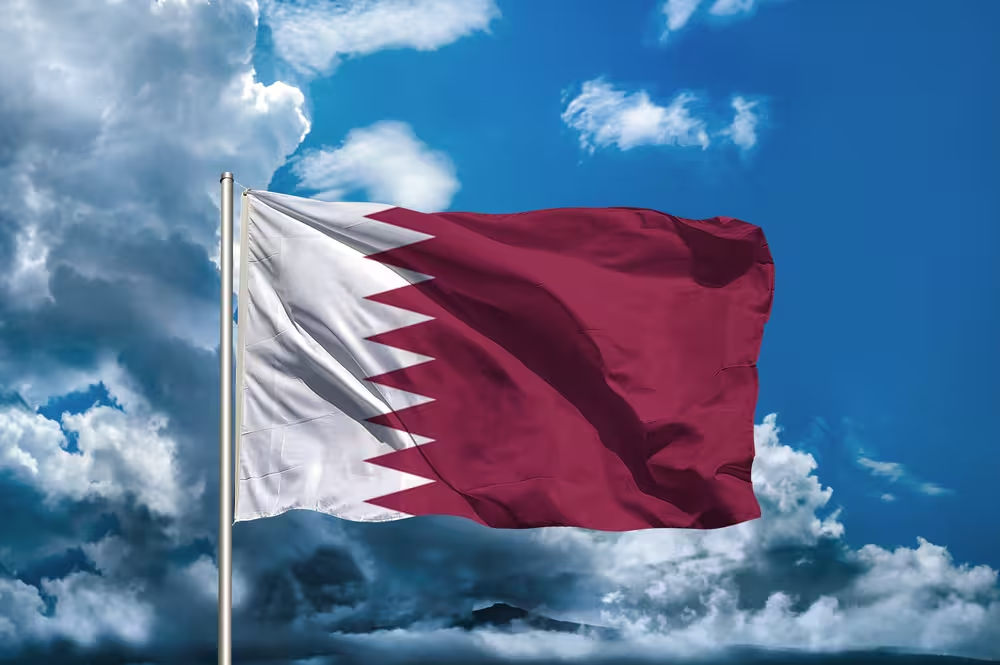
Qatar denounces Israel over a strike in Doha that killed members of Hamas and a Qatari security officer. Prime Minister Sheikh Mohammed bin Abdulrahman Al Thani called the attack state terrorism and warned it undermined Qatar’s mediation efforts. His remarks came as Arab and Muslim ministers prepared for a summit on a coordinated response.
Qatar calls Israeli strike an attack on mediation
Sheikh Mohammed said Qatar remained committed to working with Egypt and the United States on a ceasefire in Gaza. He argued the strike in Doha, which killed six people, was not only an attack on individuals but also on Qatar’s role as mediator.
“The reckless and treacherous Israeli aggression was committed while Qatar was hosting official negotiations with the knowledge of the Israeli side,” he said. “It aimed to sabotage efforts to secure a ceasefire in Gaza.”
The prime minister stressed that Israel’s actions violated international law. He described them as state terrorism pursued by an extremist government.
Arab states demand accountability
The Arab League’s Secretary-General Ahmed Aboul Gheit also condemned Israel. He warned that silence in the face of what he called crimes would only encourage more violence.
Sheikh Mohammed urged the global community to act decisively. He said it was time to end double standards and punish Israel for repeated attacks.
Israel defends its actions
Israel has not issued an official response to Qatar’s statements. However, Prime Minister Benjamin Netanyahu defended the strike in a social media post. He claimed Hamas leaders in Qatar were blocking ceasefire negotiations and prolonging the conflict.
“Removing them would eliminate the main obstacle to freeing hostages and ending the war,” Netanyahu said.
His comments came as U.S. Secretary of State Marco Rubio visited Israel, a trip watched closely in light of the Doha attack.
Hamas reaction to Qatar’s stance
Hamas official Bassem Naim welcomed Qatar’s position and expressed hope that the upcoming summit would produce a united Arab-Islamic stance. Hamas has long relied on Qatar as a host for its political leadership, with the arrangement supported by Washington as a way to maintain communication channels.
Background on Qatar’s role
Qatar has positioned itself for years as a mediator in regional conflicts. Its government has hosted Hamas leaders at the request of the United States to enable dialogue with Israel. The latest strike puts that role under strain.
Netanyahu has repeatedly threatened Hamas leaders wherever they are based. His government has criticized Qatar and warned it could be targeted as long as Hamas operates from its territory.
Rising pressure on Netanyahu
The Israeli government faces growing pressure at home over hostages still held in Gaza. Officials say 48 remain, with 20 believed to be alive. Families of hostages have demanded stronger action, while others question the strategy behind targeting Hamas abroad.
According to local health authorities, Israeli offensives in Gaza have killed more than 64,000 Palestinians since the war began. About half of the dead are reported to be women and children, though officials do not specify how many were fighters.
The conflict started when Hamas militants attacked southern Israel on October 7, 2023, killing 1,200 people and abducting 251.
Regional implications
The Doha strike highlights tensions over Qatar’s mediation role. By targeting Hamas leaders in the capital, Israel escalated risks for a state long involved in negotiations. Analysts expect the summit of Arab and Muslim nations to push for a more unified stance, though divisions remain.
For Qatar, the attack is not only a national security issue but also a challenge to its position as a diplomatic broker. Sheikh Mohammed’s remarks signal Doha will demand international accountability while maintaining its role in ceasefire talks.